SHARE
in
𝕏

Are 2D Drawings Still Used?
TL;DR
By the numbers
Leadership's view
Why the shop floor needs it
What needs fixing
FAQ
Why does leadership see 2D drawings as dead cost?
From the top, a drawing looks like a translation step ‘low value added’ that shouldn't need to exist. You already built a fully defined 3D model. Turning it into a 2D document feels like retyping something you've already written. The industry even has a name for the alternative, model-based definition (MBD), where the tolerances and notes live on the 3D model and the drawing goes away entirely.
From the top, a drawing looks like a translation step ‘low value added’ that shouldn’t need to exist. You already built a fully defined 3D model. Turning it into a 2D document feels like retyping something you’ve already written. The industry even has a name for the alternative, model-based definition (MBD), where the tolerances and notes live on the 3D model and the drawing goes away entirely.

On paper, MBD wins. In practice, it keeps hitting the same wall: the shop floor isn't ready to consume it nor see it. Teams that try MBD-first often hear the same request back, "can you turn it into a drawing, because we're not there yet." One shop wanted the drawing printed at 1:1 scale on a single large sheet so a machinist could lay the part on top of it. That's not a company behind the times. That's how the work actually gets done.
On paper, MBD wins. In practice, it keeps hitting the same wall: the shop floor isn’t ready to consume it nor see it. Teams that try MBD-first often hear the same request back, “can you turn it into a drawing, because we’re not there yet.” One shop wanted the drawing printed at 1:1 scale on a single large sheet so a machinist could lay the part on top of it. That’s not a company behind the times. That’s how the work actually gets done.
Here's what the top of the org chart sees clearly: the hours to create the drawing. That's fair. Detailing is slow. But three costs stay hidden from that view.
Here’s what the top of the org chart sees clearly: the hours to create the drawing. That’s fair. Detailing is slow. But three costs stay hidden from that view.
The cost of checking. Every drawing gets reviewed, and review is expensive. As the same aerospace lead put it: "you've not only got the cost of the drawing, you've got the cost of checking the drawing."
The cost of checking. Every drawing gets reviewed, and review is expensive. As the same aerospace lead put it: “you’ve not only got the cost of the drawing, you’ve got the cost of checking the drawing.”
The cost of style variation. Even with a company standard, different people draw differently. His analogy: it's like calling a plumber to look at the last plumber's work, "I wouldn't have done it like that, I'm going to rip it all out and start again." A checker looks at a drawing, decides it's junk, and it gets redrawn. That rework never shows up as a line item.
The cost of style variation. Even with a company standard, different people draw differently. His analogy: it’s like calling a plumber to look at the last plumber’s work, “I wouldn’t have done it like that, I’m going to rip it all out and start again.” A checker looks at a drawing, decides it’s junk, and it gets redrawn. That rework never shows up as a line item.
The cost of the thing not existing. Kill the drawing and you don't save its cost. You increase it esponantially ebcause at that point you will have to work around with the bad parts you have and the moulds you have ordered that do not fit the assembly
The cost of the thing not existing. Kill the drawing and you don’t save its cost. You increase it esponantially ebcause at that point you will have to work around with the bad parts you have and the moulds you have ordered that do not fit the assembly
What is a 2D drawing, and are 2D drawings still used today?
A 2D drawing is the dimensioned, toleranced document a shop uses to make and inspect a part: views, dimensions, GD&T, notes, and a title block. It's the instruction set the machinist, the inspector, and the supplier all read from.
A 2D drawing is the dimensioned, toleranced document a shop uses to make and inspect a part: views, dimensions, GD&T, notes, and a title block. It’s the instruction set the machinist, the inspector, and the supplier all read from.
And yes, 2D drawings are still used almost everywhere. The survey data above says it plainly: even among teams that have fully adopted 3D CAD, roughly three in four still lean on a drawing as the deliverable. The drawing didn't survive out of nostalgia. It survived because it's still the thing the floor trusts.
And yes, 2D drawings are still used almost everywhere. The survey data above says it plainly: even among teams that have fully adopted 3D CAD, roughly three in four still lean on a drawing as the deliverable. The drawing didn’t survive out of nostalgia. It survived because it’s still the thing the floor trusts.
Every few years, someone senior looks at the engineering budget, sees the hours going into detailing, and declares the drawing dead. The model has the geometry. The model has the tolerances. Why are we still paying people to draw?
We heard the cleanest version of this from a design-process lead at an aerospace manufacturer. Describing how his own leadership sees it, he said: "Drawings are seen to be a bad thing. It's like, why are we wasting our time creating all these drawings? We should just do it all digitally." Then he added the part the helicopter view misses: "the guy who's on the machine making that part will want a drawing to print out and stick up in front of him so he can cross things off and put red lines on it. And people forget that because they haven't actually stood in front of a milling machine."
We heard the cleanest version of this from a design-process lead at an aerospace manufacturer. Describing how his own leadership sees it, he said: “Drawings are seen to be a bad thing. It’s like, why are we wasting our time creating all these drawings? We should just do it all digitally.” Then he added the part the helicopter view misses: “the guy who’s on the machine making that part will want a drawing to print out and stick up in front of him so he can cross things off and put red lines on it. And people forget that because they haven’t actually stood in front of a milling machine.”
That's the whole tension in two sentences. So let's take it seriously.
That’s the whole tension in two sentences. So let’s take it seriously.

TL;DR
Are 2D drawings still used in manufacturing? Yes, on almost every shop floor. Leadership keeps trying to kill the 2D drawing because from the top it looks like pure cost: hours spent making a document when "the model already has everything." But the person at the machine still prints the drawing and red-lines it. The value of a drawing is invisible to anyone who has never stood in front of a mill. The answer isn't to delete the drawing. It's to make the indispensable-but-hated thing cheap and consistent.
Are 2D drawings still used in manufacturing? Yes, on almost every shop floor. Leadership keeps trying to kill the 2D drawing because from the top it looks like pure cost: hours spent making a document when “the model already has everything.” But the person at the machine still prints the drawing and red-lines it. The value of a drawing is invisible to anyone who has never stood in front of a mill. The answer isn’t to delete the drawing. It’s to make the indispensable-but-hated thing cheap and consistent.
By the numbers
NIST · 2020
NIST · 2020
Reliance on 2D-based methods costs US manufacturers an estimated $5.2 billion a year, per NIST (2020).
Read source
Read source
→
→
ASME / NIH · 2016
ASME / NIH · 2016
Only 26.8% of manufacturers release most of their designs as PMI-embedded 3D models, per NIST (2020).
Read source
Read source
→
→
NIST · 2020
NIST · 2020
85% of manufacturers use 3D CAD, only 41% treat the model as the primary authority, and 74% still rely on a 2D drawing, per ASME Journal of Manufacturing Science and Engineering (2016).
Read source
Read source
→
→
In short: 2D drawings are still used because the shop floor, inspection, and most contracts run on them. The drawing is not the problem. The cost of producing and checking it is. Kill the drawing and you don't remove that cost, you push it downstream to a machinist, an inspector, or a supplier who has to rebuild what you deleted.
In short: 2D drawings are still used because the shop floor, inspection, and most contracts run on them. The drawing is not the problem. The cost of producing and checking it is. Kill the drawing and you don’t remove that cost, you push it downstream to a machinist, an inspector, or a supplier who has to rebuild what you deleted.
Why does the shop floor still need the drawing?
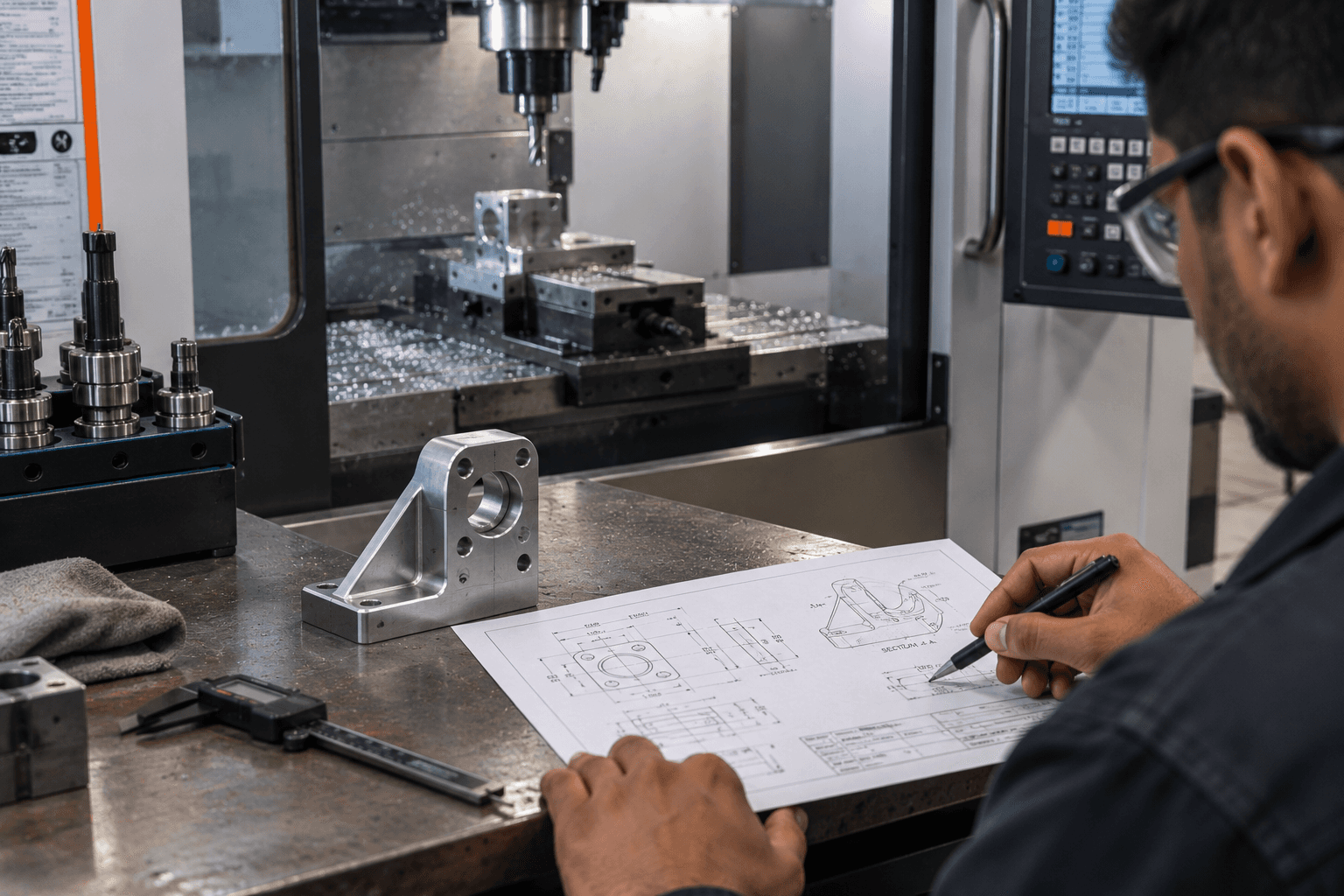
Because the machinist works from it. He prints it, marks it up, and crosses off features as they're cut. That physical workflow is real, and it's easy to forget if you've never stood at the machine.
Because the machinist works from it. He prints it, marks it up, and crosses off features as they’re cut. That physical workflow is real, and it’s easy to forget if you’ve never stood at the machine.
The people closest to manufacturing already know the drawing isn't going anywhere. "We can't get away from drawings despite what people might say," the aerospace lead told us. "When it comes down to piece parts, manufacturing of the individual parts, we really struggle to get away from a well-toleranced drawing."
The people closest to manufacturing already know the drawing isn’t going anywhere. “We can’t get away from drawings despite what people might say,” the aerospace lead told us. “When it comes down to piece parts, manufacturing of the individual parts, we really struggle to get away from a well-toleranced drawing.”
There's a deeper reason the drawing survives, too. The last 10 to 20% of any drawing isn't geometry you can read off the model. It's judgment. Which tolerances carry function. How the part will actually be machined. What it mates with. That judgment used to live in a 25-year veteran at the next bench. It doesn't transfer just because you export a STEP file. The shop drawing is where that judgment gets written down in a form the floor can act on.
There’s a deeper reason the drawing survives, too. The last 10 to 20% of any drawing isn’t geometry you can read off the model. It’s judgment. Which tolerances carry function. How the part will actually be machined. What it mates with. That judgment used to live in a 25-year veteran at the next bench. It doesn’t transfer just because you export a STEP file. The shop drawing is where that judgment gets written down in a form the floor can act on.
Model-based definition vs 2D drawings:
what's the real state of play?
Model-based definition vs 2D drawings:
what’s the real state of play?
MBD is real and it's growing, but the NIST figure is the reality check: only about a quarter of manufacturers release most of their designs as PMI-embedded 3D models. For the alternative to replace the drawing, every link downstream has to consume it natively, the machinist, the inspection department, the supplier, the contract. Most of those links still expect a mechanical drawing.
MBD is real and it’s growing, but the NIST figure is the reality check: only about a quarter of manufacturers release most of their designs as PMI-embedded 3D models. For the alternative to replace the drawing, every link downstream has to consume it natively, the machinist, the inspection department, the supplier, the contract. Most of those links still expect a mechanical drawing.
So the honest picture is not "MBD is winning" or "MBD is a fad." It's that MBD works where the whole chain is ready and stalls everywhere the chain isn't. Until that changes, the drawing is still the deliverable, and betting your process on its disappearance is betting against your own supply chain.
So the honest picture is not “MBD is winning” or “MBD is a fad.” It’s that MBD works where the whole chain is ready and stalls everywhere the chain isn’t. Until that changes, the drawing is still the deliverable, and betting your process on its disappearance is betting against your own supply chain.
Do 2D drawings still matter, or is the real problem their cost?
Both are true, and conflating them is why "kill the drawing" initiatives keep failing.
Both are true, and conflating them is why “kill the drawing” initiatives keep failing.
The drawing matters. It's the contract between your design and the shop floor. A wrong weld symbol or a missing note isn't a typo, it's a part that fails inspection, a line that stops, or a quote that balloons.
The drawing matters. It’s the contract between your design and the shop floor. A wrong weld symbol or a missing note isn’t a typo, it’s a part that fails inspection, a line that stops, or a quote that balloons.
But the drawing isn't the problem. The cost of producing and checking the drawing is the problem. Those are different things. When leadership tries to delete the drawing, they're attacking the deliverable when they should be attacking its cost. The deliverable is load-bearing. The cost is optional.
But the drawing isn’t the problem. The cost of producing and checking the drawing is the problem. Those are different things. When leadership tries to delete the drawing, they’re attacking the deliverable when they should be attacking its cost. The deliverable is load-bearing. The cost is optional.
What actually needs fixing?
If the drawing is indispensable and the cost is the problem, the goal is obvious: make a correct drawing nearly free to produce, and consistent every time.
That means generating the first-pass drawing automatically from the 3D model, dimensioned to function, from a sensible datum scheme, so engineers spend their time reviewing and approving instead of laying out views and dragging dimensions. It means one consistent house style instead of the checker-versus-checker rework. And it means keeping a human in the loop, because that last 10% is judgment, and judgment should be approved, not guessed.
This is the problem we built hanomi to solve. hanomi, an AI tool that generates production-ready 2D manufacturing drawings from 3D CAD models, produces accurate drawings for parts and full assemblies automatically, built to your company's own drafting standard. It learns how your team dimensions from the drawings you already have, so the output looks like your best detailer made it, and it flags anything ambiguous instead of inventing a number. You approve every drawing before it ships.
This is the problem we built hanomi to solve. hanomi, an AI tool that generates production-ready 2D manufacturing drawings from 3D CAD models, produces accurate drawings for parts and full assemblies automatically, built to your company’s own drafting standard. It learns how your team dimensions from the drawings you already have, so the output looks like your best detailer made it, and it flags anything ambiguous instead of inventing a number. You approve every drawing before it ships.
We're not trying to abolish the drawing. We think the person at the machine should get to keep the sheet they red-line. We just think making it shouldn't cost an engineer a day.
We’re not trying to abolish the drawing. We think the person at the machine should get to keep the sheet they red-line. We just think making it shouldn’t cost an engineer a day.
See it on your own geometry: [generate your first drawing free at hanomi.ai](https://tryhanomi.com).
See it on your own geometry: [generate your first drawing free at hanomi.ai](https://tryhanomi.com).
See it on your own geometry: [generate your first drawing free at hanomi.ai
Frequently Asked Questions?
Still Matters
Still Matters
Still Matters
Still Matters
Still Matters

Marco Mascolo
Founder & CEO
Are 2D Drawings
Still Used?
Are 2D Drawings
Still Used?
Are 2D Drawings
Still Used?
Are 2D Drawings
Still Used?
Are 2D Drawings
Still Used?
Jul 6, 2026



Stay in the loop
Subscribe to get notified about new articles, engineering insights, and product updates from Hanomi.
Subscribe to get notified about new articles, engineering insights, and product updates from Hanomi.
Subscribe